As the team and I unloaded out of the bright, orange Land Rover my eyes locked on this 3-year-old girl. Her skin was dark brown and ashy. Above her lip was harshly dried skin mixed with dirt. She had crusted snot below her pig-like nose. Her hair looked like a combination of frosted tips from the 90s and miniature doorknobs. Her name was Karsva.
She was squatted in a frog position eating a fruit with the outer texture of plastic and inner texture of thin woodchips. You would think you were looking at the feet of a 60-year-old woman when glancing at the deep cracks in her heels. Her feet matched the color of the sandy ground looking as though it hadn’t received rain in years. Behind her was a run down schoolroom, roaming chickens, lambs, and many other children like her.
The school kids were like cartoon characters and wore the same outfit week after week. Karsva was no exception. Her purple, dirt-covered shirt read ‘Born to be Spoilt’. I almost laughed.
Before reaching Karsva my team and I had many long days of traveling and training before us. My team of nine met in Fort Wayne, Indiana. From there we traveled to Chicago, to Heathrow, London, to Johannesburg, South Africa, to Windhoek, Namibia, to Outjo, Namibia, and finally to Swartbooisdrift, Namibia where many of the Himba reside. These days of travel allowed our team to become unified while understanding the goals of the Immersion Program and many cultures within Africa. Training let us focus on the beauty in what we believe to be the same of God rather than our differences in denomination.
Immersion is a missions program that turns the question asked to most people going on mission, “What are you doing?” into, “How will you live?” Immersion promotes the task of (or should I say lack there of) building authentic relationships. We did not build, fix, or give away material items while in Namibia; we brought only our stories in Christ. Although there were tangible ways we served, like teaching at the local school, relationships came first.
Immersion desires for their teams to ‘live the local way.’ This doesn’t mean taking on their ancestral beliefs, but simply walking their roads, singing their language, drinking their water, and if your lucky enough dressing as they do. This intentional living paves the way towards meaningful conversations and relationships. In this, our team was taught to back the local ministries (Kunene For Christ) in Swartbooisdrift. We were reminded that we aren’t starting the fire, but pouring gasoline on the few there who know Christ and are trying to make Him known. (S/O to the Schoemans)
One could argue a month to be a long or short-term mission. Comparatively, to the other short-term, one week, or 10-day missions I’ve been on, this was not a short-term mission. I believe some short-term missions tend to benefit more the missionaries than those being missioned too. Not to discredit short-term missions. Is it not good the believers on these trips grow in their relationship with Christ? Immersion promotes the belief that life is too complex to be bettered by actions done in just a few days. Missioners will go to Africa with no concept of what destitute poverty actually looks like and once they sincerely smell-not see but smell-true poverty, they become broken. It’s then more about them than about what they came to do. Again, those short-term missions are what got me here; I would never discredit them.
The American personality tends to hold high problem solving skills and great confidence in expressing oneself. But this leads Americans coming to Africa wanting to solve it. Immersion knows you can’t solve Africa. I learned quickly that just because people aren’t doing things a certain way, or even the most efficient, doesn’t mean they are wrong. Different doesn’t mean wrong.
In general, when combining Americans with Africans, what can we expect?
As an American who has lived in Africa for one month, I would agree with the Africans; they are more relational than us. Not to say we aren’t relational, but they will do anything, say anything, and not say anything for a relationship to be positive. Relationships are everything.
Lastly, Immersion doesn’t chance material things to hinder relationships during missions. I thought this to be extreme until I went on the mission. Our team of nine was the first of any Immersion team to live in Swartbooisdrift. Whether we wanted to or not we were setting the tone for every other team potentially coming to Swartbooisdrift. We wanted to set a tone of equality. How could you set a tone of equality when you are always the giver and never the receiver? It takes a lot to realize sometimes when we give we take away and we take away dignity. When you take away dignity, or when one in a relationship cannot give back, the relationship can only go so far. Immersion never wants to chance the deepening of relationships and sharing Christ genuinely so we were encouraged not to give money or any material items to the people we met. If we truly saw a need we discreetly gave. “You should give to people who need help. But do not let anyone know about it,” (Jesus). Sometimes “anyone” needs to include those we give to.
After understanding and agreeing with what Immersion is all about my team and I met our partnering missionaries, Hine and Helene, in Outjo, Namibia. They were like a mom and dad to us who exuded God in every way, and are probably the coolest people I’ve ever met.
The first and most important thing Hine and Helene taught me about the difference between Africa and America is explained through one of their sayings, “we build the plane as we fly it”. They do not have a schedule in Africa. If they do it is a rough draft of the next few hours in the day. The number one thing of importance in Africa is relationships. Hine & Helene spoke of a time they went to a Starbucks when visiting America. They said they were shocked by the response of the people in line behind them when they asked the barista what he or she recommended. “Everyone seemed as though it was life or death depending on how fast we ordered,” said Helene. She got me wondering what is the most important thing to Americans? Without wondering long I came to my confident answer: success. Success can be different for everyone. Success is money, success is time, success is tasks, success is a goal, and I would go as far to say I have achieved success in a relationship. Time controls Americans often because of our need for success.
Although it was difficult for my teammates to adjust to this concept of time it was evident I struggled the most. I am certainly guilty of having time as my control in leading me to success. Of course Americans are not heartless creatures who care nothing about relationships, but perhaps we tend to only care for family or a handful of close friends. Even then, I am surely guilty of putting my schoolwork, social life, church standing, earnings, and many other things before those who mean so much to me.
Within the first few days I realized the perpetual relationship of Africa and America. While my mission and team aimed for equality not many American and African relationships have equality or are even striving towards it.
Outside of leading Immersion Missions Hine is a speaker and what I would call an agricultural engineer. He will go into a town and see what the town is all about, observe for a while, and ask himself: what resources do they hold? What kind of community are they? He then will use what resources they have to sustain life, create jobs, and work with what they can produce on their own rather than bring in outside assets. All the while he encourages those villages in Christ and shares God’s beauty.
When you continually supply people with material things it forces them to be reliant. While in Namibia I was told about this woman and her family who were the soul shoemakers of their town; they were the only ones to go to if in need of shoes. Did they always have materials for every part of the shoe? No. Did they always have every size? No. Did they always have enough shoes to go around? No. But that job of making shoes is what gave this woman and her family money. What brought food to their stomachs each night. Then an outside group of people came to the town to deliver a couple hundred shoes! The town was thankful! Children were so happy to have new, colorful shoes! Then the group of people took their pictures and left. The family of shoemakers was no longer needed. They began to have no way of making money and could no longer feed themselves. Eventually, members of their family pass away because they couldn’t afford food. But good thing they had the perfect fit and color shoe when saying goodbye to their loved ones.
Disclaimer, not all organizations are bad. Toms, for instance, researches and even asks for feedback from the towns they donate to all the while creating jobs in Haiti to help supply these shoes.
I just wonder why we wouldn’t we send an expert to that same town to teach one of their people how to make shoes for themselves? It would save the dependent relationship and let those people help themselves long-term.
I realize unless one becomes involved with an organization you cannot change them sending what they send. What I can change is researching those organizations I choose to donate too. I encourage you to find out about the organizations you give to before donating to third world countries. Some of the highly needed items in third world countries (although need replacing at some point as well) is medical equipment.
My team and I were interacting with such young children at one of the schools in Outjo we wouldn’t translate anything, but just play games together. On the first day we realized this small girl sitting in a small chair while the other kids would play active games with us. It wasn’t until the last day we found out she declined our offer to play everyday because her legs did not work. We just assumed she was in time out or did not want to play with us because she never left her chair. We held a hand out to her she could not grab onto everyday. It was a sight to see her crawl, using nothing but her arms to move her entire body across the dirt floor. She seemed to be last in getting anywhere and not included in the children’s friendship. It almost doesn’t faze you in the moment because it is a bit surreal. It got me thinking about how the quality of her life could be improved immensely by someone donating one wheelchair. So hear me when I say don’t stop giving just do some research and make sure your serving is in fact aiding others.
Hine, “Africa is America’s dumping ground.” Some organizations help but many organizations hurt. Even if they are helping, for instance those shoes going to a town that had no shoemakers, what are those people really giving but a few months of having shoes? The gift only lasts as long as it works. Eventually it will need to be replaced and guess who doesn’t have the power to replace. We didn’t teach them. Why send hundreds of shoes when we can send one expert? I have never seen so much truth behind the saying, “Give someone a fish and you feed him for a day. Teach someone to fish and you feed him for a lifetime” (Lao Tzu).
I am not the first person to realize this concept of “When Helping Hurts (Thank you Corbett & Fikkert). But from all this I asked why? Why does America get into this giving cycle? We know it creates dependency. We know it’s not the most efficient way. Is it is because we want a successful business? We are problem solvers after all. Why?
It’s because of our worldview.
America and Africa have so many differences that it causes their people to have opposing world perspectives. Immersion taught me Africa fits under the category of Animism/Traditional Religion while America would fit under the other worldly view of Secularism/ Materialism. By definition, Animism is a view that non-human entities-such as animals, plants, and inanimate objects-possess a spiritually essences; it is a foundational thread of indigenous peoples’ “spiritual” or supernatural perspectives and was around before the development of organized religion. Secularism is the separation of church and state while straying away from religion in the direction of modernization.
Out of the six topics of study pointing America and Africa back towards these categories I will share two. Essentially, epistemology is the study of knowledge. Africans view the questions asked by this field, e.g. “How do I know?” and “What do I know?” by looking towards meditation and mystery, while Americans will study facts and information. We think ‘I have the right to know’ and crave information to be in control. Second category: Ontology. This is the study of the nature of being and existence that points to the question: “What is mankind?” Africa would answer that humankind can only be in a group. You only matter when part of something bigger and many are required for you to have significance. In this field of study America dishes out the importance of individualism to us everyday, with a side of materialism. We are looked as consumers.
Our worldview changes how we see things. We may truly believe ‘I am right here’ when of course looking through our American lenses we would seem right. It’s hard to take a different perspective when your lenses are the only ones you’ve ever looked through.
After learning about Africa we then focused in on Namibia. I thought it silly. We had just learned so much about Africa, how much more could I learn? Then it dawned on me how different the people on my team were. Usually, everyone we met would be impressed we were from America. They clumped us together as Americans when as the days went on we realized how different we all were just being from separate places in America. I know some of my northern teammates were introduced to the many slang terms of the south like fix’n, y’all, and yonder. How inconsiderate of me to think I should be able to clump an entire continent together when I felt offended by others not paying attention to the differences within my team from the same country.
I learned Namibians never leave a piece of food on their plates, are extremely dependent on South Africa economically, and have quite a bit of material poverty. Most of what I learned about Namibia was from living there. Their major religion is Christianity due to mission work done in the 1800s and they have only had independence since 1990.
Next we learned about Swartbooisdrift and the Himba culture. Imagine missionaries coming to America to spread Christ to the people living in our Indian Reserves. The missionaries only learning about one town, then returning home to tell others what the Americans were like, would leave their listeners with an extremely skewed view of America and her people. Again, zooming in and learning even more about the people and culture was so important.
Swartbooisdrift is home to many OvaHimba (plural for Himba people) and is located in Northern Namibia in the Kunene region. There is around 45,000 OvaHimba left and they make up less than 10% of the population of Namibia. Herero is a cultural term for an ethnic group that compromises subdivisions of people including OvaHimba. The more rural OvaHimba live in ongandas (home land of their marked territory) far away from other ongandas, which consisted of huts made from tree branches and a dried dirt material.
Their women dress in a lot of handmade jewelry and beading, a heavy skirt made from goat or calfskin, and nothing covering their top half. The men wear skirts as well, with a string around their waist with a piece of cloth shoved in the front and back for coverage. Both sexes wear otjize all over their bodies. Otjize is a dark red paste that protects from the sun and holds many other health benefits. Their hairstyle and jewelry choices signify age or rank.
The more modernized of the OvaHimba lived in huts right next to each other, somewhat like a neighborhood. Almost all kids were a bit more modernized than their parents because some attended government schooling. Those modernized kids would wear cloth t-shirts and skirts or shorts.
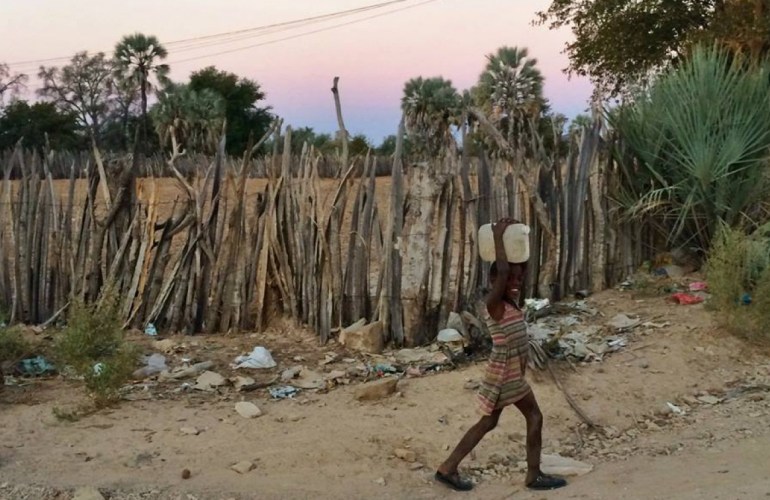
The children in Swartbooisdrift had only one set of clothing, the one on their backs. They had not more than one meal a day and always less than what was needed. There is poverty… and then there are these kids. At least that’s how I saw it at first. Then I was asked to redefined poverty.
Poverty can mean to lack something, anything. The deficiency of a person can go further than material items, for instance someone can lack relationally, spiritually, physically, emotionally, mentally, even financially. Although Africa is in material poverty, one could argue America is in far more poverty than any other country. Unfortunately, my worldview tells me how poor Africa is when truly some of the OvaHimba are the richest humans I’ve ever met.
We filled our days in Swartbooisdrift with sharing the gospel to villages, teaching at the local school, and playing in fellowship down by the river in the late afternoons.
When I say villages I mean families. Villages would range anywhere from a small family of 6 to an extended family of 15 to 20. Bedeni, our main translator, knows the people and community. Each day she planned our visits to those villages asking if they would grant us permission to come hangout with them.
We would follow close behind Bedeni entering each village, making sure to avoid the okuruwo (sacred ancestral fire). Then, shake the hands of each Himba and greet them in their language. After, we all sit on the ground and talk for long periods of time discussing who we are and where we came from while learning how the OvaHimba do life. Eventually we would share about Jesus, which was a lot more difficult than expected. It takes a lot longer to share about Jesus when every word coming from your mouth needs to be translated or defined in a different manner. A word as simple as ‘good’ means something different to different cultures. It is hard to continually pause in your thoughts when explaining the gospel. Attempting to exclude any religious terminology lead to limited words when trying to expand as well. Let’s just say God had many chances to shine through our weakness. And He did. I treasured the simplification of God and His love after each sharing.
After visiting a couple of villages two teammates and I would walk a few miles down the road to the school. The school is where I met Karsva, the girl I mentioned earlier. The school consisted of a one-room building and a few tents set up behind it. The tents (provided by the government) were the classrooms for the older grades while Karsva and her 3 years old friends were in the one-room building. The children made pathways and fences with rocks to make the landscape look a bit more than it was. There we taught one 4th grade class math and English while the other team members persisted in meeting other villages. We grew to love the students we worked with and taught them the multiplication table using jumping jacks. I’ve never seen kids have more fun with math.
It was a hard reality the first day in class. We arrived to no lesson plan just a few books. Each kid had a paper booklet filled with maybe 100 pieces of paper for the entire year. Only half the class had a writing utensil. The books told us the kids should be ready to learn long division. As I began teaching- keep in mind English is their second language- I realized all were lost. We backed it up to the basics and asked if the students knew multiplication. They answered with a confident yes. Putting their knowledge to the test we asked them to solve: 12 x 9. Too much time had past and I assumed they did not know how to reach the answer. After 5 minutes I was told they needed more time. I did not understand why they wouldn’t admit they didn’t know how to work the problem. Then we found out about their tally system. To get to the answer one would tally out 12 dashes then circle it and do that 9 times and count the outcome. Just take that in for a moment. This is how these kids are taught multiplication. This is the math they will rely on in life. I had to ask myself if this was a way of doing life different or if it was something I should intrude on.
For the best interest of the students Jamie, a teammate, and I decided to teach them the multiplication table. We simply wanted them to be able to handle higher math problems. Both ways worked, that wasn’t the problem in this situation. It was assuming. We assumed they were on schedule. We assumed they knew multiplication, and not just that, but that they knew multiplication our way. This again was a perfect example of the need to redefine when interacting with different cultures. Redefining words is redefining communication.
Around 3:00 pm my teammates and I would head down to the Kunene River. We were so far north in Namibia we could actually see Angola across the water. The place we went to play everyday felt like a dream. The afternoons were cooler and near the river were many palm trees and greenery unlike the rest of the town. The light brown, powdery sand leading to the blue-green river made us feel in a consistent cloud of haze. With nothing in the sky but the sun we would play games, perform skits, pray, sing and dance in glorification of God. Those afternoons were some of the best I’ve ever had. Now, I may be partial because a love of my life is dancing, but I would certainly place watching those children dancing, singing, and praising with us to our Father in Heaven in the top five moments of my life.
One of the last days we were dancing and praising it hit me hard. We spent so many days with these children and we could barely talk to them. The few words that were translated were about our stories of God and our prayers over them. We truly didn’t know much about their thoughts and opinions. We only knew two things. One: what we studied about their life that told us of their environment filled with rape, abuse, lack of food, lack of rain to produce food, alcoholism, and disease. Two: My team and I knew we were called to show the love of God to these children.
Actions were the way we learned about each other. Every time we saw these kids they ran to us wrapping their arms around our necks as someone who hasn’t seen their loved one for many years. We learned those kids don’t let the world make them numb. They have not let their pain make them hate. They have not let their bitterness steal their sweetness. For no reason these kids love. They love like no other children, no other people I’ve ever met. Although not all of them know God they have shown me what His love can do, and what His love can look like. Smiling. Giving a hug to someone. Playing with someone. Spending your time with someone. Looking to someone to make them feel like a daughter or son of God. They love like they are never going to run out. I hope they know their love comes from the ultimate action and sacrifice of God. Actions speak love.
I’ve been home in America for about a month now and my thoughts about Immersion have been centered on two things. First, how many people? How many people did I really proclaim the good news of Jesus Christ to that month? Did I use my resources wisely? Could I have reached more people were I living here in Tennessee? What if I only reached one person? Then I remembered what Hine and Helene told me, “You can count the number of seeds in a mango (one) but you can’t count the number of mangos in a seed.” There is only one seed in a mango so you are only reaching one person when you share Christ to someone. But you can’t count the number of mangos that will come from one seed. You don’t know how many followers will come from the one follower you reach. One mango seed can produce and entire forest of mangos! The size of your seat in this world doesn’t matter. The amount of people who hear your words doesn’t matter. Just tell those you know because you never know how many mangos will come from that single seed.
Lastly, I’ve thought about worldview, asking myself if the views are really that different? I came to the conclusion of yes. But although we have different worldviews we have the same creator. Both worldviews need a scriptural view they don’t have. We are different in what we value but not in what we truly need. We need to look at Epistemology and not think facts or meditation alone but reflect on the truths in the scripture, applying them and encountering revelation and manifestation. We need to look at Ontology and not believe merely in the individual or that one has no meaning unless in a group, but we were individually created in the image of God (Imago Dei) and we were meant to work together as the body of Christ. Both worldviews request many of the same prayers to God.
No matter what worldview, no matter where you’ve lived your life, no matter the things in your hand or the spirits in your soul. We all have those in need of health and healing. All parents want the best for their kids. We all were born in the image of God. We all need God; we are all spoiled by God. Spoilt by God’s mercy and grace. His Grace is something we all need. Despite the numerous differences in culture and worldview the Kingdom is open to everyone. God giving us the love we don’t deserve and holding back what is deserved spoils us. Karsva’s shirt is less of a laugh and more a reality that we all (in a way) were ‘Born to be Spoilt’.
 Tori Churchill